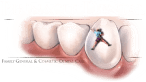
Oral Lesion Removal in Holladay, UT
If a sore, ulcer or patch inside your mouth has not healed in about two weeks, Dr. Cannon can take a look and remove it if that is needed.
Most sores in the mouth clear up on their own within a week or two. When one does not, it is worth having someone look at it rather than watching it for another month. Dr. Cannon will examine the area, tell you plainly what he is seeing, and go over your options before anything is decided.

Sometimes ulcers and canker sores can be abnormally large, or they can cause severe pain that inhibits oral functions. If they do not go away after two weeks, we highly suggest coming to see our dentist for treatment. Dr. David S. Cannon can look at the lesion and see if it is related to something else, specifically oral cancer, and can remove the affected area using a soft tissue laser. Call Pinnacle Dental at 801-274-3889 to schedule your oral lesion removal treatment in Holladay, Utah, today!
Oral lesion removal, or oral lesion excision, is a surgical procedure recommended to remove a sore, ulcer or patch from the inside of your mouth. These lesions may develop on the inner lip, cheek lining, gums, tongue, or the floor or roof of your mouth. Depending on your individual needs, your oral lesion removal could be the only treatment you need, or it could be part of a greater overall treatment plan.
When you receive a lesion removal treatment, our dentist will begin by providing you with an anesthetic to ensure that you remain comfortable during your procedure. We will then carefully extract the lesion from your mouth. Please be aware that some tissue that looks healthy may also be removed from the extraction site around and under the lesion to help ensure that the lesion is fully removed. Our dentist will then apply any medications, sutures or bandages to the area to control bleeding and help prevent infection while you heal. The lesion tissue will then be sent to a lab and tested to determine whether or not it is benign and if any additional treatments are needed.
After your lesion removal, you may experience some swelling, redness or bleeding near the surgical site. You may also find that you have some difficulty in fully opening your mouth for a few days after your procedure. This is normal, and you should heal within a day or two. Our dentist and team will provide you with post-op instructions to help you heal and recover, and we encourage you to contact us immediately if you experience severe pain, heavy bleeding or other problems.
If you have any questions about oral lesion removal or would like to set up an appointment with our dentist, please contact our office today.
Reasons people come in for this
- A canker sore or ulcer that has not healed after about two weeks
- A white or red patch inside your cheek, lip or gum that keeps coming back
- A lump or bump on your tongue, gum or the roof of your mouth
- A sore spot that makes eating, talking or wearing a denture painful
- A growth that keeps getting bitten or catching on your teeth
- Something in your mouth has changed and you would rather know than wonder
What it does for you
- The sore spot stops getting irritated every day
- You get an answer instead of watching and waiting
- Eating, talking and brushing become comfortable again
- The area is fully numbed before anything is done
- You go home with clear instructions for healing
About Oral Lesion Removal
An oral lesion is any sore, ulcer, lump or patch on the soft tissue inside the mouth. Most are harmless and short-lived: a bitten cheek, a canker sore, a spot rubbed raw by a denture edge or a sharp filling. Removal is a small procedure done with the area numbed, and it is usually a short appointment. Dr. Cannon looks first and talks it through with you before any decision gets made.
- For sores that will not heal
- Numbed first, usually a short visit
- Plain answers, no guesswork
- Clear aftercare instructions
Benefits of Oral Lesion Removal
A sore that keeps returning to the same spot is usually telling you something, whether that is a rough edge on a tooth, a denture that needs adjusting, or a habit like cheek biting. Having it looked at means the cause gets dealt with, not just the symptom. And when something has sat there for weeks without changing, knowing what it is beats worrying about it. That is not a question to answer from home.
What to Expect
This appointment is usually shorter and less involved than people expect. Dr. Cannon looks first, tells you what he sees and what he does not, and answers your questions before anything else happens. If removal makes sense, the area is numbed thoroughly, and what you feel is mostly pressure. You leave with written aftercare instructions and our number. We would far rather you called with a small question than sat at home wondering.
Common Questions
Does this mean I have oral cancer?
Will it hurt?
How long does the appointment take?
What will it cost?
Should I just wait and see if it goes away?
Terms You May Hear
- Lesion
- A general word for any sore, ulcer, lump or patch of changed tissue. On its own it says nothing about whether something is serious.
- Benign
- Not cancerous. Most lesions found in the mouth turn out to be benign.
- Sutures
- Small stitches used to close an area after tissue is removed so it heals cleanly. Some kinds dissolve on their own.
Ready to Schedule Your Appointment?
Call 801-274-3889 and we will get it looked at.